After years of wearing eyeglasses and even spending time immersed in the world of optics, helping countless individuals find their perfect pair, I've amassed a wealth of practical knowledge that I'm eager to share. I truly understand the struggle of choosing the perfect eyeglasses. It’s a journey I’ve taken many times myself, often feeling overwhelmed by the sheer number of styles, materials, and trends. From the initial excitement of picking new frames to the eventual disappointment of an ill-fitting or uncomfortable pair, I've experienced it all. This guide isn't just theory; it's a collection of my personal discoveries, hard-won lessons, and the simple, actionable advice I now swear by to ensure your next pair of glasses isn't just functional, but also a joy to wear and a reflection of your best self.
My immersion in the world of optics began with a genuine fascination, and it quickly became clear that choosing eyeglasses is an art form intertwined with science. I remember vividly when an experienced frame specialist shared what he called the "three holy rules" of frame fitting. While the specifics of all three emerged over time with my own practice, one rule stood out immediately: frames should never extend like aeroplane wings out past your face, especially for those with delicate or smaller features. This was a profound revelation for me, instantly highlighting why some of my past choices felt "off." When frames are too wide, they not only look disproportionate, making your face seem narrower than it is, but they can also cause discomfort by not distributing weight correctly, leading to slippage or an awkward feel.
Before truly internalizing these core principles, I, like many others, often found myself swayed by fleeting fashion trends. I recall a distinct period, around the late 2000s, when a particular celebrity's glasses became an overnight sensation. Everyone wanted that look! I’d see these trendy frames everywhere and think, "That’s it! That’s the style that will make me feel fashionable and confident." But time and time again, after purchasing such a pair, I’d face the harsh reality: what looked absolutely stunning on a celebrity didn't necessarily translate well to my own unique facial structure. The allure of the trend often overshadowed the fundamental importance of fit and comfort. I distinctly remember buying a pair that felt stylish in the store but, within days, I realized they pinched my temples, constantly slid down my nose, and fundamentally broke almost every fitting rule I would later discover. It was a disheartening realization, but it truly cemented in my mind that genuine fit and personal suitability trump fleeting fashion every single time.
One of the most persistent and frustrating fitting challenges I've encountered, both in my own experience and while assisting others, involves individuals with a less prominent or "no bridge" nose. This is a facial feature I've observed is quite common, particularly among Asian women, and it creates a unique set of problems for traditional frame designs. For years, I struggled immensely with plastic frames that would constantly slide down my nose, resting uncomfortably low on my cheeks, or even leaving red marks. My eyelashes would often brush against the lenses, and the overall look felt perpetually "off." It felt as though my options for stylish plastic frames were severely limited, forcing me to often settle for designs that felt bland or simply didn't express my personality.
This recurring problem, however, led me to a truly game-changing discovery: certain frame styles, like the wayfarer, and frames with specific bridge designs can make a monumental difference for those of us with wider faces or less prominent nose bridges. While many traditional plastic frames lacked the necessary support, I found that wayfarer-style frames, with their often wider and more robust bridge construction, could provide the crucial lift and support needed. Furthermore, frames equipped with adjustable nose pads, whether plastic or metal, became invaluable. These pads allow for customization, ensuring the glasses sit at the correct height and distance from the face, preventing slippage and cheek contact. This insight truly opened up a world of stylish possibilities that I had previously considered out of reach, and the relief of finally finding a plastic frame that sat perfectly was immense.
Another significant hurdle I've personally faced is finding suitable frames for very strong prescriptions. My own prescription is quite high, often resulting in lenses that, even after being thinned, can still be notably thick – affectionately (or sometimes not so affectionately) referred to as "coke bottle" lenses. This challenge makes the search for attractive and functional frames incredibly difficult. Many delicate, thin, or rimless frames simply cannot accommodate the thickness and weight of stronger lenses. They can make the glasses feel unbalanced, prone to falling, or even visibly distort the look of the frame itself, with the thick edges of the lenses protruding unattractive from the sides. I've spent countless hours trying on frames, only to be met with the disheartening phrase, "Sorry, your lenses won't sit well in these," or to see the optical technician shake their head as the heavy lenses made the frames tilt. It often felt like I was constantly compromising on style, forced to prioritize functionality and stability over aesthetics.
Through all these trials, errors, and continuous learning, I’ve cultivated a much more strategic and confident approach to choosing glasses. Here are the core principles and effective solutions I've gathered, which I believe will help anyone navigating the eyewear landscape:
For my "coke bottle" lenses, I quickly learned that certain frame styles and materials work significantly better at both accommodating the lens thickness and minimizing its visual impact. I gravitated towards frames with a slightly thicker rim or a more robust, full-rim design. These styles provide more material to encase the edge of the lens, effectively camouflaging its thickness. Full-rim metal or acetate frames often prove to be excellent choices, as their inherent structure can better support and visually hide the edges of thicker lenses. While some might think thinner frames make thick lenses less noticeable, I found the opposite to be true; delicate frames actually highlight the lens thickness. Moreover, choosing a slightly larger frame can also help, as the lens can be cut in a way that minimizes edge thickness when centered within a larger frame area. This approach finally gave me the confidence to wear my glasses without feeling self-conscious about my prescription.
During my extensive search for frames that could not only handle my thicker lenses but also offer a sophisticated and comfortable wear, I focused on quality materials known for their durability and lightness. I wanted something that felt substantial enough to support my prescription without adding undue weight to my face, and something timeless in style. This rigorous search for the perfect combination eventually led me to explore titanium frames, a material renowned for its exceptional strength-to-weight ratio and hypoallergenic properties.
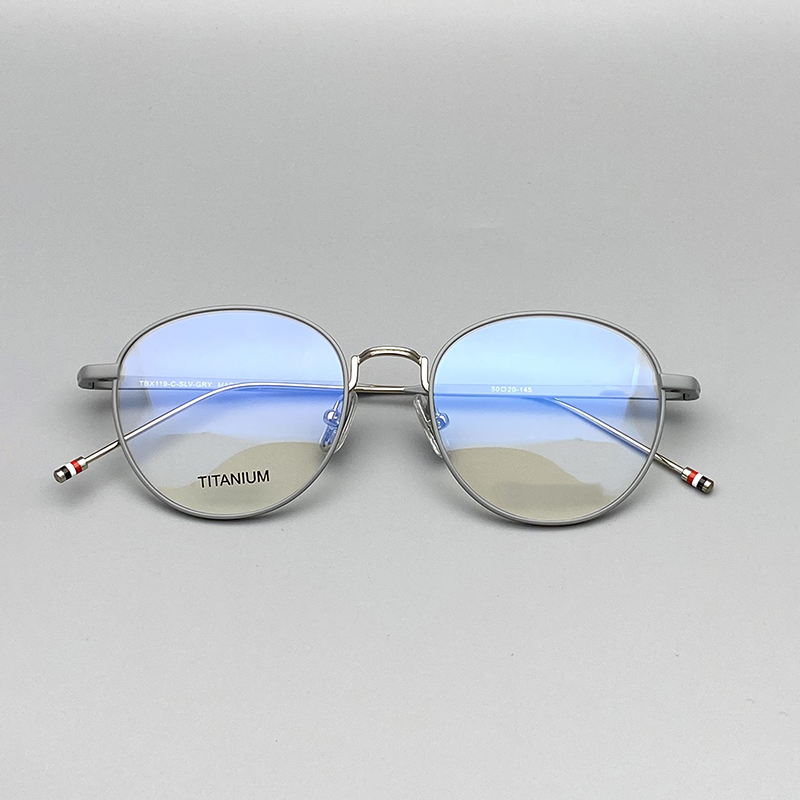
I eventually discovered the Prescription Eyeglasses Frames TBX119 Optical Myopia Glasses Men Pure Titanium Frame Retro Reading Glasses Eyewear Thom Brand Gray. Despite the "Men" in the product title, I found these frames to be incredibly versatile and suitable for a wide range of individuals, including myself. The pure titanium construction was an immediate standout feature; they are astonishingly lightweight yet remarkably sturdy, which is precisely what I needed to comfortably hold my heavier lenses without feeling them drag on my nose. The retro "Thom Brand" style exuded a sophisticated, intellectual appeal that was neither overly bulky nor too delicate, making my thick lenses far less noticeable within their robust yet elegant structure. The subtle, versatile gray color also contributed to their timeless charm. These frames quickly became a personal favorite because they seamlessly blended aesthetic appeal with critical practical functionality, finally offering me a comfortable, stylish, and durable solution for my strong prescription, truly enhancing my experience of choosing the perfect eyeglasses.